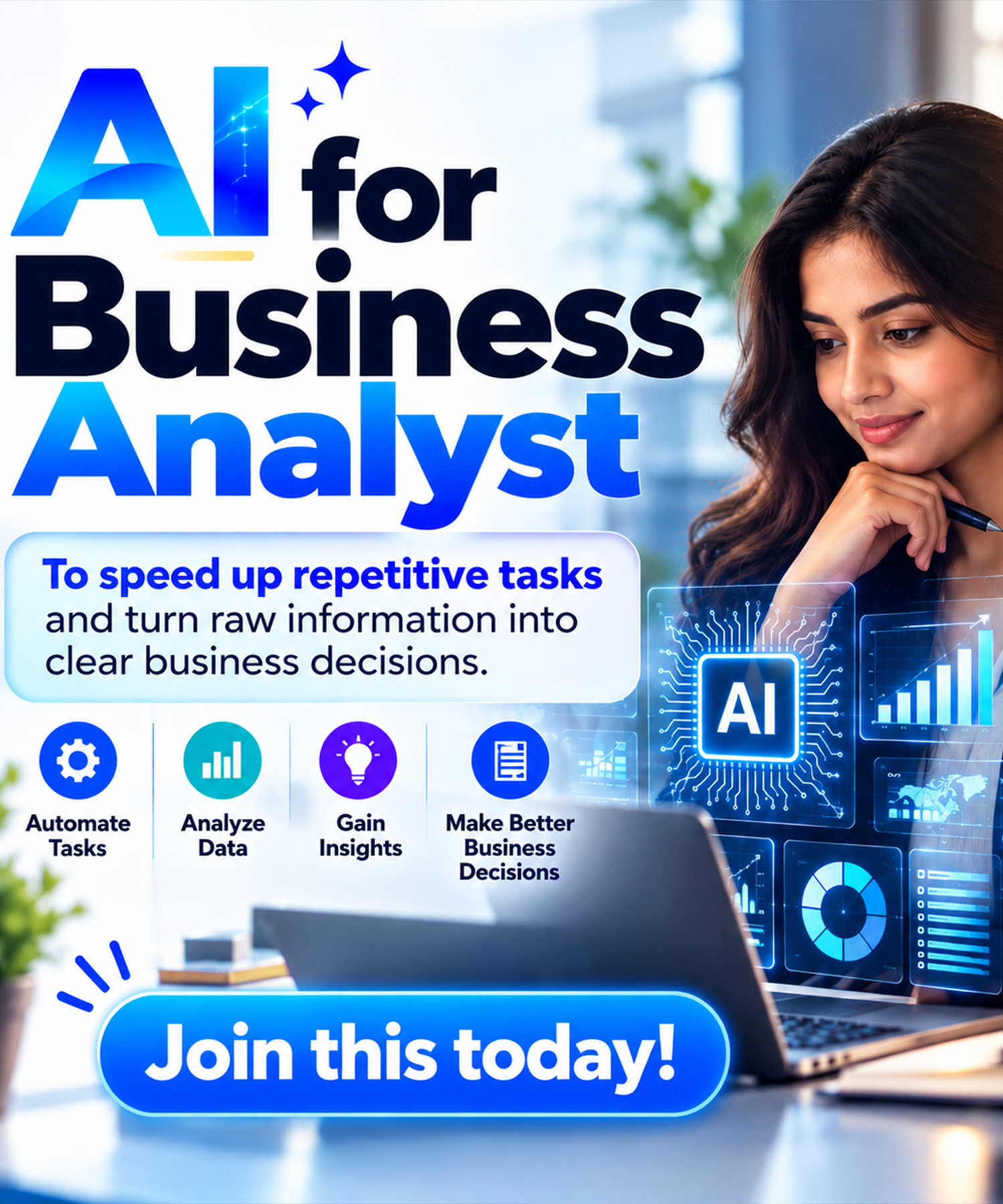
Module 01 – AI Foundations & Prompt Engineering for Business Analysts
• Understanding AI, Generative AI, and their applications in Business Analysis.
• Understanding AI capabilities, limitations, hallucinations, and reliability.
• Writing effective prompts for Business Analysis tasks.
• Using context, roles, examples, constraints, and structured outputs.
• Building reusable AI prompts for everyday BA activities.
Module 02 – AI for Business Problem Analysis & Critical Thinking
• Identifying and clearly defining business problems using AI.
• Root-cause analysis and structured problem investigation.
• Breaking complex business problems into manageable components.
• Generating and comparing possible business solutions.
• Using AI to support critical thinking without replacing human judgement.
Module 03 – AI for Requirements Engineering
• Using AI to support requirements elicitation and stakeholder discussions.
• Generating and refining functional and non-functional requirements.
• Creating user stories, acceptance criteria, and business rules.
• Identifying ambiguous, incomplete, conflicting, and missing requirements.
• Organizing, prioritizing, validating, and documenting requirements.
Module 04 – AI for Business Process Analysis & Improvement
• Understanding and documenting existing business processes with AI .
• bottlenecks, inefficiencies, risks, and unnecessary activities .
• Supporting process mapping and As-Is/To-Be analysis.
• Generating process improvement and optimization opportunities .
• Evaluating proposed process changes and their expected business impact.
Module 05 – AI for Business Data Analysis & Insights
• Using AI to explore spreadsheets, datasets, reports, and business information.
• Identifying trends, patterns, anomalies, relationships, and performance issues.
• Analysing KPIs and comparing business performance.
• Creating visualisations, summaries, and management-level insights.
• Converting data findings into actionable business recommendations.
Module 06 – AI for Business Research & Market Intelligence
• Conducting market, industry, competitor, and customer research using AI .
• Analyzing reports, documents, websites, and large amounts of business information.
• Identifying market trends, opportunities, threats, and changing customer needs.
• Comparing competitors, products, services, and business approaches.
• Transforming research findings into structured business insights.
Module 07 – AI for Stakeholder Analysis & Communication
• Identifying and analyzing stakeholders, interests, influence, and expectations.
• Preparing stakeholder interviews, questionnaires, workshops, and meetings.
• Summarizing discussions and extracting requirements, decisions, and action items.
• Creating professional emails, reports, presentations, and executive summaries.
• Adapting business communication for technical, managerial, and non-technical audiences.
Module 08 – AI for Business Strategy & Decision Support
• Conducting strategic analysis using SWOT, PESTEL, competitor, and business environment
analysis.
• Identifying business opportunities, risks, constraints, and strategic challenges.
• Developing and comparing alternative business scenarios and solutions.
• Evaluating alternatives using business value, feasibility, cost, risk, and expected impact.
• Preparing evidence-based recommendations for management and decision-makers.
Module 09 – AI for Solution Evaluation & Business Cases
• Identifying and comparing potential solutions to business problems .
• Evaluating feasibility, benefits, costs, risks, assumptions, and constraints.
• Developing AI-assisted business cases and cost-benefit analyses .
• Defining KPIs and success criteria for proposed solutions.
• Preparing clear solution recommendations for stakeholder approval .
Module 10 – AI Automation & the Future of Business Analysis
• Identifying repetitive Business Analysis activities suitable for AI automation .
• Using AI tools and agents to automate research, documentation, analysis, and reporting .
• Designing AI-assisted Business Analyst workflows .
• Applying responsible AI, privacy, security, ethics, and human oversight .
• Developing a personal AI-enabled Business Analyst workflow and future skills roadmap.


 +94 11 754 4801
 info@sliit.lk